
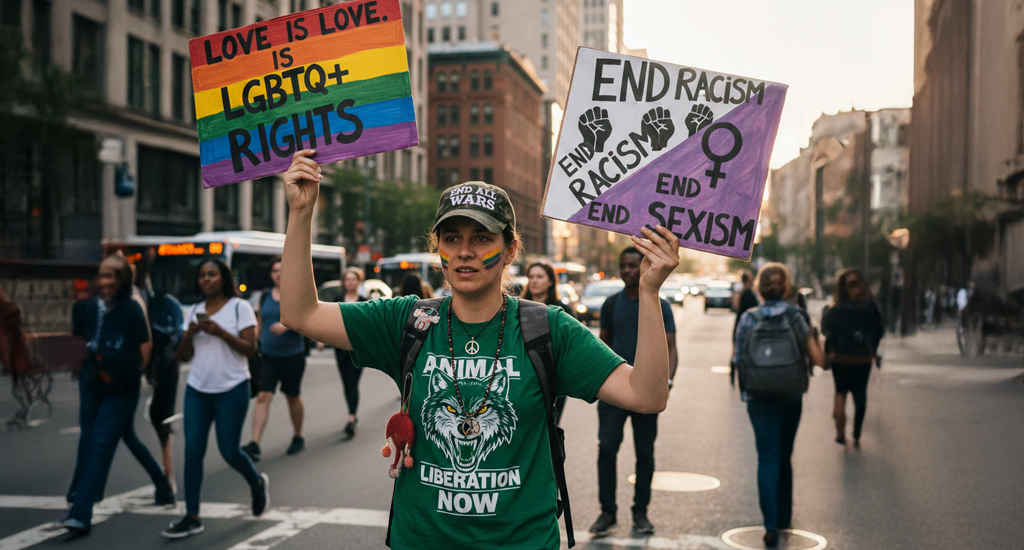
 AI-generated image
Intersectionality is a theoretical concept that emerged from Black feminism. It was coined by the legal scholar Kimberlé Crenshaw in 1989 to describe how a person’s social and political identities, such as race, class, gender, sexual orientation, and disability intersect. Rather than treating these categories separately, intersectionality argues that experiences of discrimination and privilege cannot be understood in isolation; they are deeply interconnected.
For example, the experience of a Black woman is not simply the sum of discrimination for being a woman plus discrimination for being Black. Her experiences are unique and shaped by the intersection of these identities.
Racism, sexism, homophobia, classism, xenophobia, and speciesism are some examples of discrimination, each with different levels of prominence depending on geographic location, the politically incorrect “isms,” as some would say. Groups that fight one of these “isms” are often criticized for not focusing on others or for being too narrowly focused on a single issue. In other words, they receive excuses or public criticism questioning why they are not addressing other causes, creating a kind of hierarchy of importance.
Large portions of modern society oppose wars and discrimination based on ethnicity, race, or gender. Yet only a fraction of those people will actually raise their voices in protest. Feminist groups often philosophically include anti-racist positions; groups opposing xenophobia tend to oppose war and often adopt anti-classist stances as well. Many of these movements are also anti-colonialist and anti-classist.
Within these movements, some people define anti-capitalist positions as integral to social struggle, and with good reason. However, this revolutionary stance is somewhat distant from a purely anti-discrimination approach centered on formal or visible traits—the search for fairness regardless of appearance, form, color, race, age, and the most elusive category of all: species.
Anti-speciesism stands somewhat apart. Only a fraction of the previously mentioned movements share this perspective. However, those who advocate for animals often share several of the other positions. In other words, advocacy for the abolition of discrimination based on species is less popular than other forms of activism.
Perhaps the groups most typically affected by intersectional pressure are those fighting speciesism, animal rights movements. A very common response among people experiencing cognitive dissonance, feeling repulsion toward animal exploitation while continuing to consume animals, is to bring up other social problems, wars, or forms of discrimination, and challenge activists by asking why they are not fighting for those causes instead.
Could this public criticism be causing a decreasing number of anti-speciesist movements that now shift their focus toward other issues? As the saying goes, “those who try to cover everything end up squeezing nothing.” Attempting to understand and take on multiple problems in a kind of complex messianic impulse can lead to ineffectiveness in one cause or another. This is especially true in such a small movement: less than 2% of humanity adopts veganism, and only a subgroup of that percentage actively advocates for animals. In this context, intersectionality—rather than promoting awareness—can result in a loss of focus and momentum, pushing activists toward more popular struggles.
This dynamic creates a hierarchy of oppressions, where some causes are perceived as more urgent or more valid than others. This could discourage those dedicated to animal advocacy, since the most exploited beings on the planet, animals, are often dismissed or minimized, placing this struggle at the bottom of the hierarchy.
Is it more effective for the movement to focus monolithically on its own cause, leaving individuals to decide whether to participate in other struggles?
Or is it necessary to find a way to show solidarity with other social justice movements without losing focus on the abolition of speciesism?
Without diminishing the efforts of any group advocating for social justice, in my view dedicating 90% of an activist’s time and energy to a single cause may be far more effective than dividing that effort among dozens of struggles. Achieving measurable impact requires organizers, not just followers, and sustained commitment. These elements become diluted when attempting to pursue multiple objectives—objectives that may even encourage fragmentation and act as a veil over local issues and more fundamental ethical principles.