
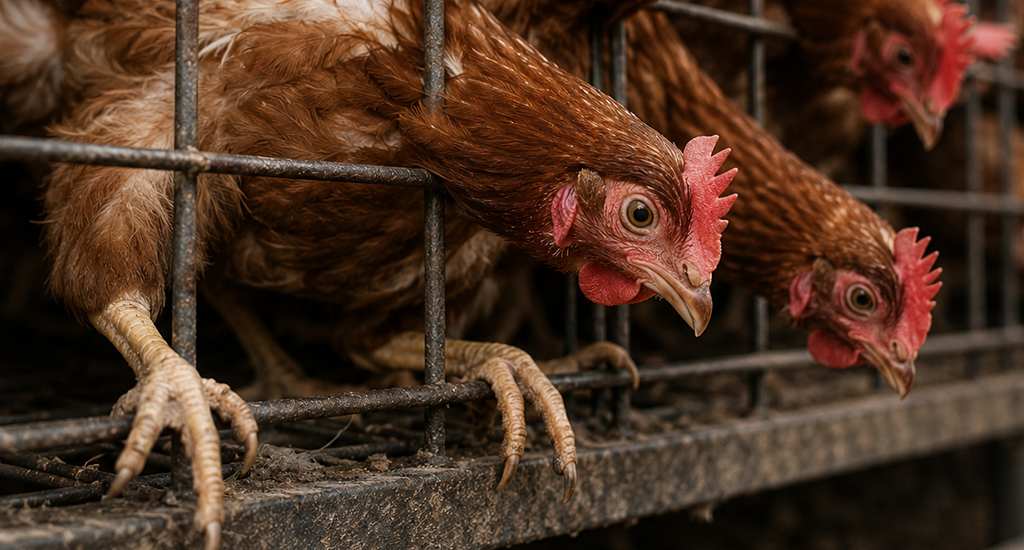
AI generated image
Hen’s Conditions and the Ethical Dilemma
Egg hens endure horrible conditions, confined in small, barren battery cages where they can barely move and can’t even spread their wings. Chickens are indeed one of the most exploited creatures on Earth, with over 6.2 billion slaughtered every month for meat and over 8 billion hens kept in egg production.
Source: Food and Agriculture Organization of the United Nations (FAOSTAT)
The egg industry is the meat industry. Male chicks in the egg industry are ground alive since they will not produce, and laying hens will end in the slaughterhouse a few years after they have been drained in egg farms. Laying hens have short lifespans,their natural lifespan is around 8–10 years. In the industry they live 18-24 months.
Modern laying hens have been selectively bred to produce around 250–320 eggs per year, many times more than their wild ancestors, placing considerable physiological demands on their bodies, causing diseases and early deaths.
This debate ends up being the old one amongst abolitionists vs welfarists. First let’s look at some facts and numbers.
Cage-Free Corporate Campaigns
Corporate cage-free campaigns emerged during the mid-2000s (approximately 2005–2008)., Mainly in countries like the US, Canada, and several European countries.
Some of the organizations behind these campaigns are:
- Animal Equality
- Animal Justice
- Compassion in World Farming
- Humane World
- Mercy For Animals
- The Humane League
Has Egg Consumption Increased After Cage-Free Campaigns?
Worldwide egg consumption has increased substantially since 2000, but this is driven overwhelmingly by Asia, population growth, and rising incomes, not by animal welfare campaigns.
This distinction is important because the major cage-free campaigns occurred mainly in North America and Europe, where the trend has not changed.
A critic could otherwise say: «Look! Egg consumption increased!» But correlation isn’t causation.
Numbers on Egg Consumption
Statistics taken from Our World in Data for egg consumption per capita.
Per Capita Egg Consumption (kg per year) |
||
|
Location |
2005 |
2023 |
|
Worldwide |
8.15 |
10.65 |
|
North America |
13.76 |
15.96 |
|
Europe |
12.54 |
13.96 |
|
South America |
7.31 |
12.63 |
|
Asia |
8.27 |
11.91 |
|
Oceania |
5.9 |
6.29 |
|
Africa |
2.31 |
2.27 |
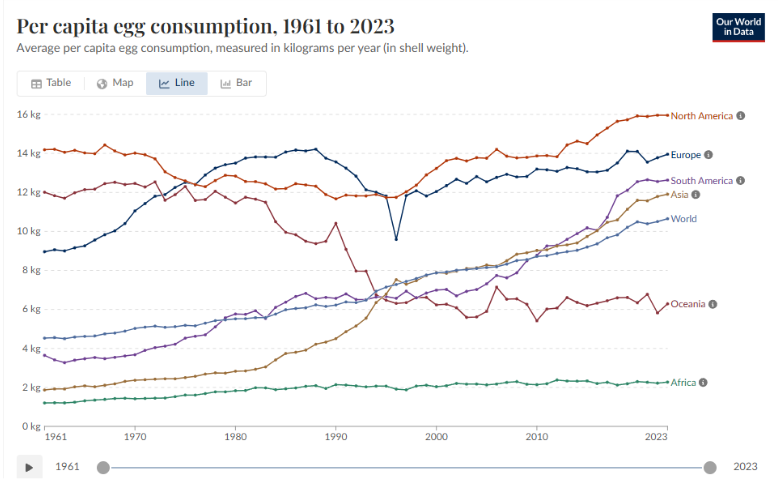
Per capita world consumption in 2023 averaged 10.65 Kg per year following a steady rising trend since 1980.
The countries with the highest consumption per capita are Belgium and Hong Kong according to the latest available data. Eastern Asia has an average of 21.92 Kg, over 6 kg more than North America.
The worldwide trend follows an almost straight line, not showing the nuances of variations in Europe and North America where consumption declined from the 70’s until the 2000s to then regrow.
Several countries in Europe have banned cages, suggesting that cage-free campaigns have had a measurable impact on public policy and industry practices. Examples include:
|
Country |
Measure |
|
Switzerland |
Conventional battery cages banned in 1992 (first country) |
|
Austria |
Complete phase-out of all cage systems by 2020 |
|
Luxembourg |
Cage systems eliminated by 2020 |
|
Germany |
Phase-out of enriched cages completed in stages (largely by 2025) |
|
Czech Republic |
Scheduled phase-out (2027) |
|
Slovakia |
Scheduled phase-out (2030) |
Meanwhile, the European Union banned conventional battery cages in 2012, although enriched cages remain legal in many member states.
Our World in Data now tracks the share of hens in cage-free systems, showing dramatic increases in many countries over the last decade.
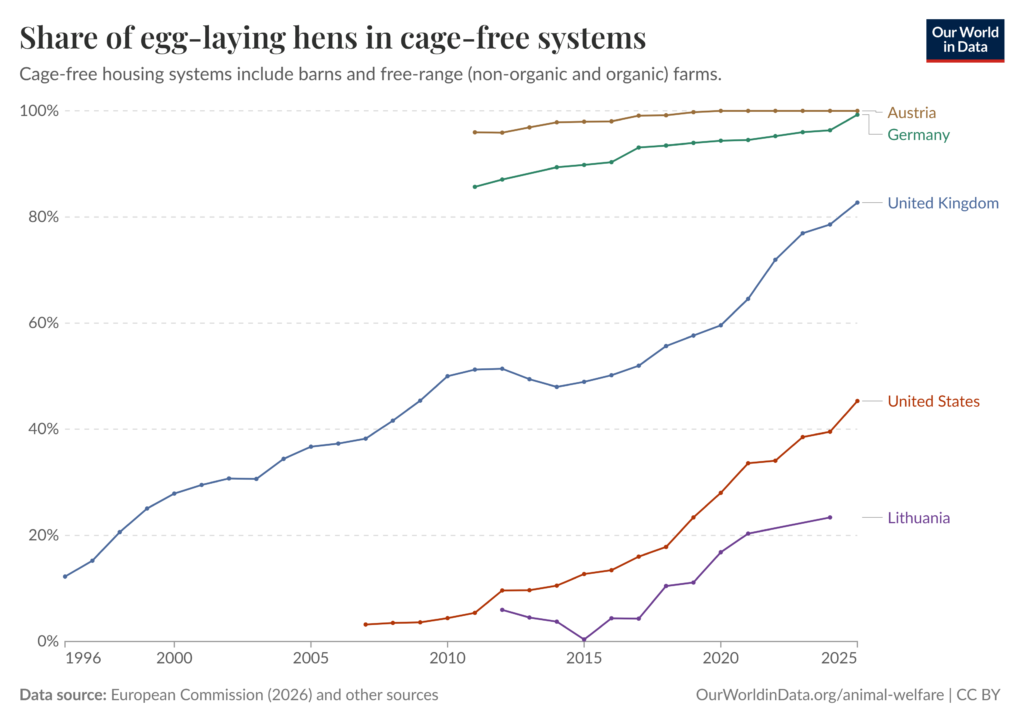
https://ourworldindata.org/grapher/eggs-cage-free
Conclusion on Egg Consumption Numbers
Available evidence does not suggest that cage-free campaigns have substantially increased egg consumption. Global egg consumption has risen over the last decades, but this trend is largely explained by population growth and increasing demand in developing economies rather than animal welfare advocacy. What cage-free campaigns demonstrably have achieved is a shift in production practices: millions of hens have been moved from conventional battery cages into cage-free systems, governments have adopted stricter welfare regulations, and consumers have become more aware of the conditions in which laying hens are kept.
Reasonable disagreement remains over whether welfare reforms delay the abolition of animal exploitation. Regardless, campaigns are advocating for better conditions, for less suffering. By doing this they promote justice and compassion, and they also spread awareness.
Thoughts on Welfarism
Welfarist campaigns have a potential effect on large populations. I believe they are not only valid to fight injustice and cruelty. They do work to create awareness, to expand consciousness on a large scale. After all laws come and go, but the public perception, the ethical drive awakened is what makes change last. If consumers demand it, producers must follow. Maybe some day a critical mass of consumers will demand zero exploitation, leading producers to focus only on plant– based products.
Suppose, hypothetically, that cage-free campaigns did increase egg consumption by 2% directly.
It could still be argued that the increase was ethically justified if it reduced suffering for hundreds of millions of hens.
Human slavery was not abolished in a day, even with many knowing it is evil. And to this day it still exists in different forms in different locations. Stepping stones eased the journey to get to the point where we are. The same dynamic with progressive steps could be valid to achieve greater goals regarding animal liberation.